Multi-Instruction Multi-Shot Long-Video Editing

Thinking on Shots: Consistent Multi-Shot Video Editing with Agentic Reasoning*

An agentic framework that edits real-world multi-shot long videos from a single natural-language instruction — preserving identity, background, and camera motion.

Chenyang Wu1,†, Fuchen Long2,†, Binyuan Huang2, Xinlong Sun2,‡, Xi Chen2, Chun-Le Guo1, Chongyi Li1,§
1VCIP, CS, Nankai University  ·  2Smart Creation Platform Department, Online Video BU, Tencent
*Work done during the Tencent Qingyun Program internship.
These authors contributed equally.  ·  Project Leader.  ·  §Corresponding Author.
Project Page 📜 arXiv 🤗 MMLVE-Bench </> Code
Abstract

Editing Long Videos, One Instruction at a Time

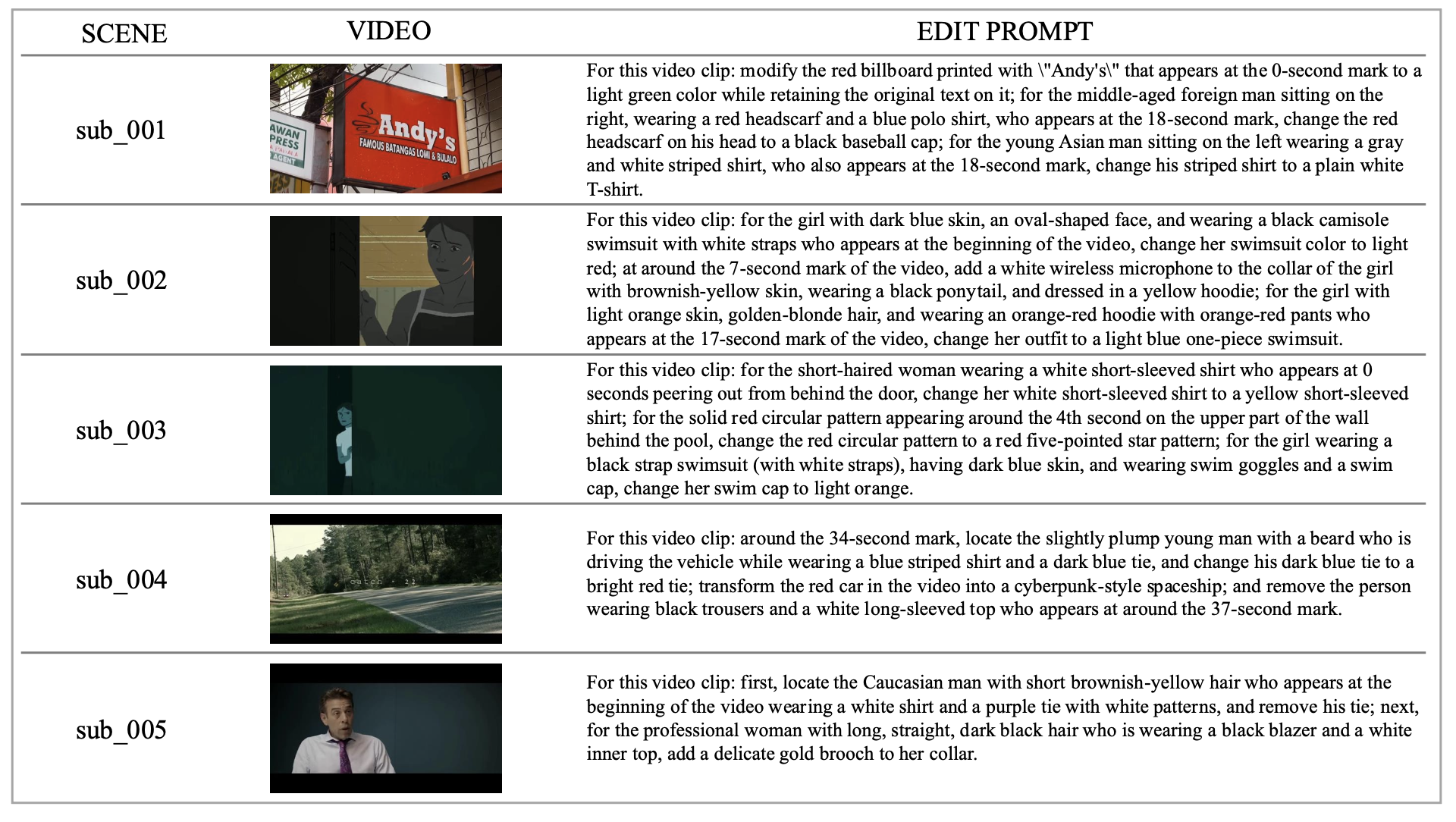
While generative AI has significantly advanced video editing, existing methods primarily focus on single-shot or short video clips. Editing long videos with multiple instructions remains a formidable challenge: naive chunking strategies (e.g., fixed-duration segmentation) often lead to entity fragmentation, severe editing hallucinations, and disrupted temporal continuity. To bridge this gap, we introduce the Multi-Instruction Multi-Shot Long-Video Editing (MMLVE) task, structured around three core objectives: Cross-Shot Editing Consistency (CSEC), Multi-Instruction Decoupling (MID), and Zero-Destruction on Spatiotemporal Structure (ZDSS). We propose an agentic editing framework that leverages the synergy of LLMs and VLMs for shot-level video decoupling and precise instruction parsing. We further construct MMLVE-Bench, a dataset characterized by complex real-world spatiotemporal dynamics, high-density heterogeneous instructions, and sparse, random entity distributions. Extensive experiments demonstrate that our MMLVE-Agent outperforms existing closed-source SOTA approaches (e.g., Seedance 2.0), eliminating editing hallucinations, preserving cross-shot editing consistency, and attaining seamless spatiotemporal transitions.
The Task

Three Core Challenges

MMLVE is defined around three objectives that naive chunking pipelines fundamentally fail to satisfy.

CSEC

Cross-Shot Editing Consistency

Keep the edited entity's visual identity consistent across every shot — no cross-shot “amnesia” or identity drift.

MID

Multi-Instruction Decoupling

Execute diverse, high-density instructions independently, without mutual interference or attribute leakage.

ZDSS

Zero-Destruction on Spatiotemporal Structure

Leave un-targeted regions, backgrounds, and camera motion completely untouched.

Method

MMLVE-Agent Framework

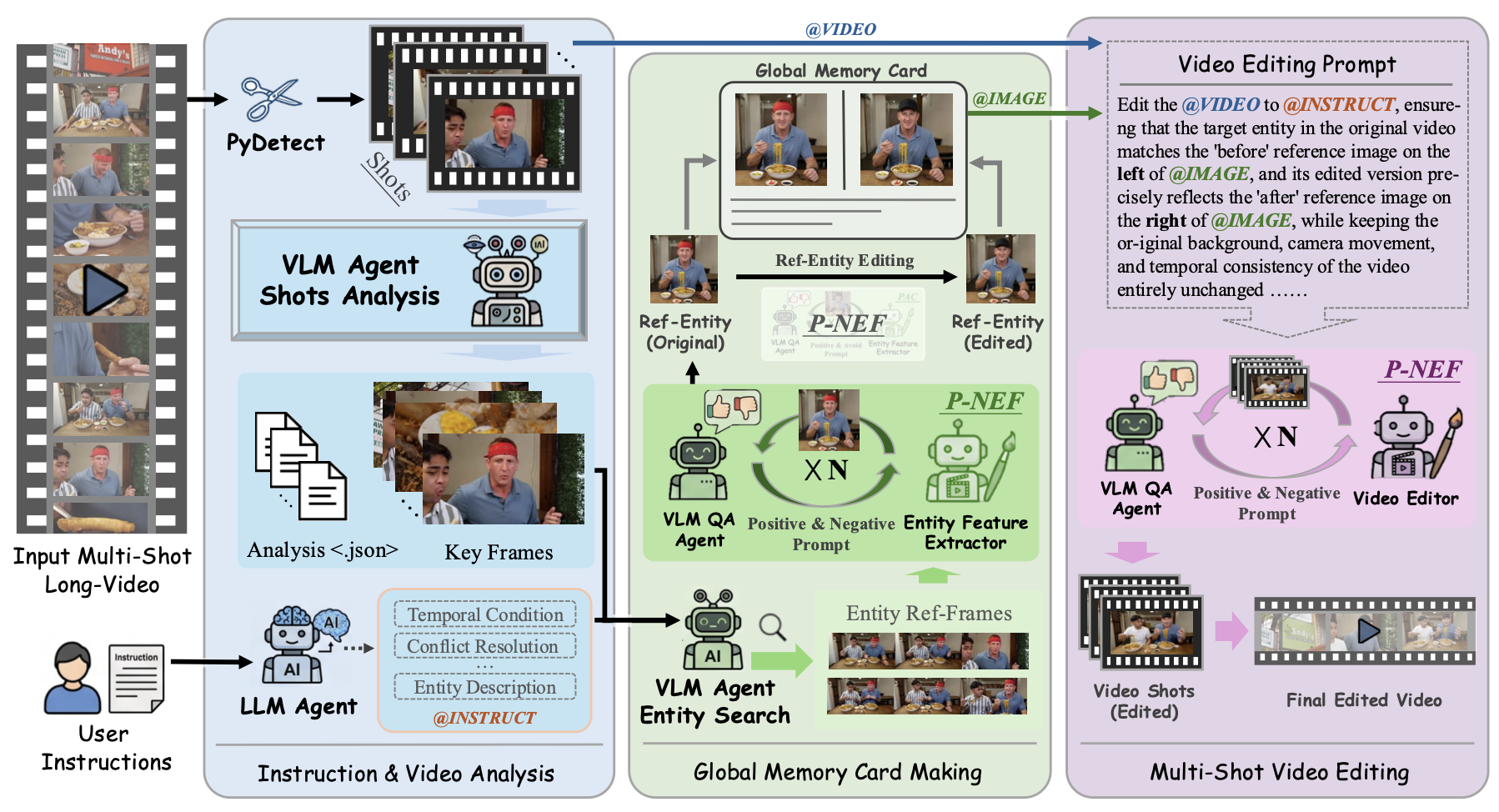
A heterogeneous multi-agent pipeline: shot boundary detection + LLM instruction parsing → per-shot VLM analysis → Global Memory Card making → reference-guided video editing & propagation → assembly.

MMLVE-Agent framework
Overall framework of MMLVE-Agent. LLM and VLM agents collaborate to decouple shots and instructions, build a global visual anchor, and propagate consistent edits across the whole video.
Mechanism 1

Global Memory Card

The top-k (k=6) highest-confidence keyframes of the target entity are aggregated into a reference grid and synthesized into a canonical reference image — a global visual anchor that guarantees CSEC & MID across arbitrary physical shots.

Mechanism 2

Pos-Neg Editing Feedback (P-NEF)

A VLM evaluator emits both a Negative Prompt (to correct errors) and a Positive Prompt (to balance the model's attention), enabling autonomous self-correction and monotonic improvement in generation quality.

Results

Qualitative Showcase

Editing results of MMLVE-Agent on complex multi-shot long videos.

MMLVE-Agent case showcase

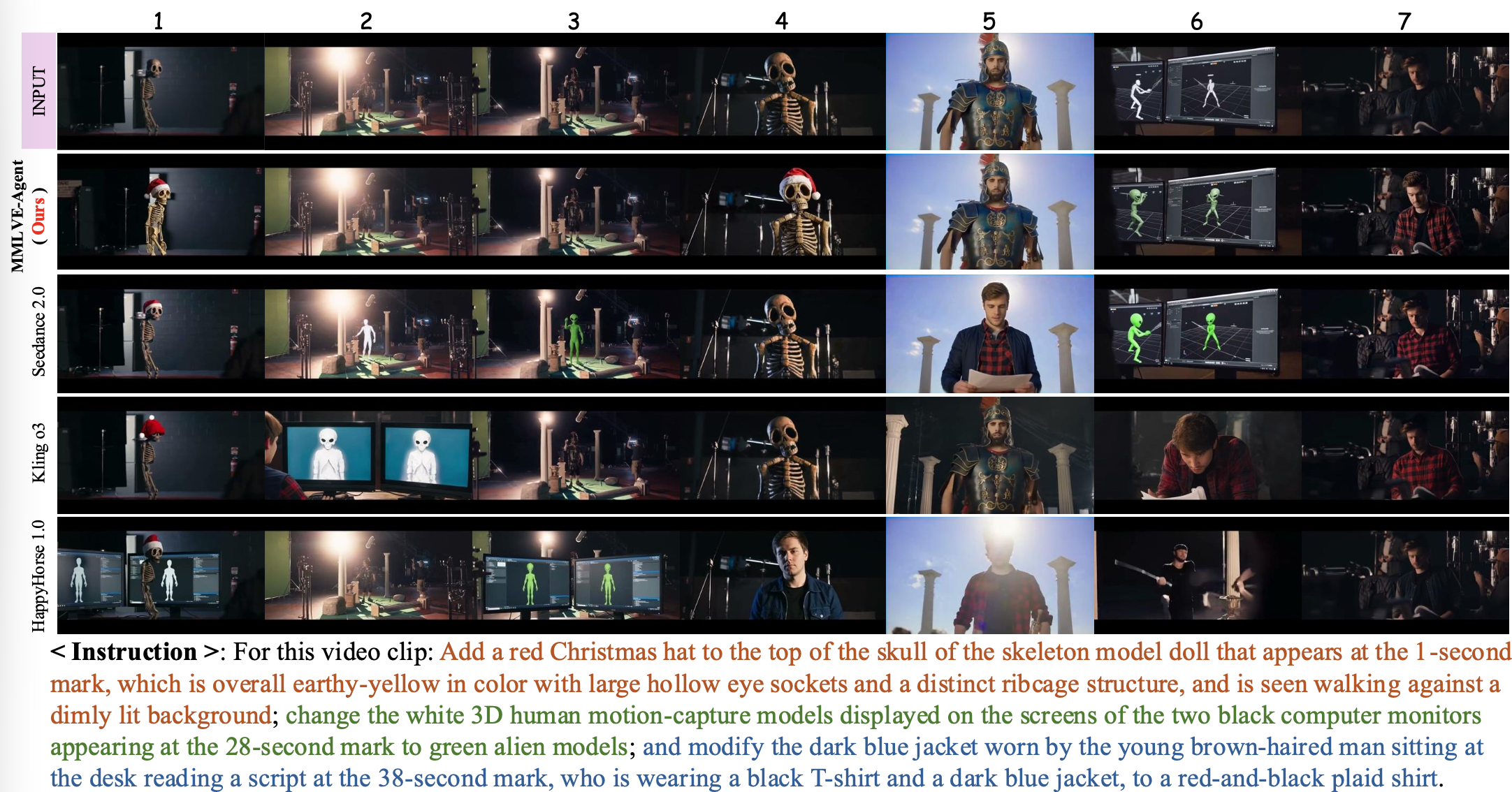
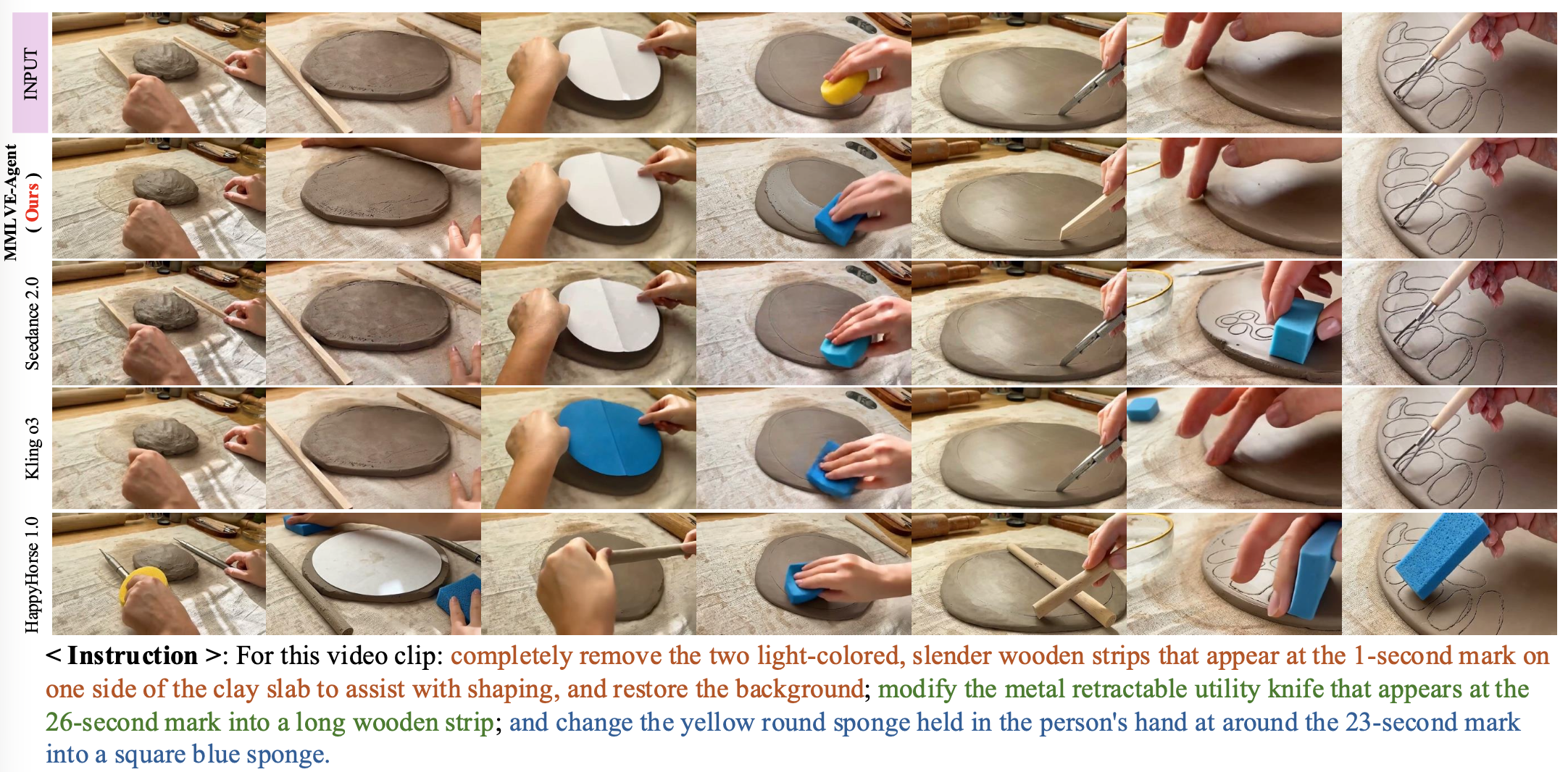
Comparison against baselines. Only MMLVE-Agent simultaneously achieves CSEC, MID, and ZDSS; baselines suffer from cross-shot amnesia, identity morphing, and destruction of un-targeted content.

Comparison with baselines (1)
Comparison with baselines (2)
Video Results

Side-by-Side Video Comparison

Each row shows the original input and the edited output of four methods on the same multi-shot long video. MMLVE-Agent (Ours) preserves consistency where baselines fail.

01
Instruction: Change the blue frame of the round wall clock to red and make it square; remove the bearded young man in the white T-shirt sitting on the far left; and put a black baseball cap on the human skeleton model. 编辑指令:把挂钟的蓝色外框改成红色并改为正方形;删除坐在最左侧、穿白色短袖、留有胡须的年轻男子;给人体骨骼模型戴上一顶黑色棒球帽。
Input
MMLVE-Agent OURS
Seedance 2.0
Kling o3
HappyHorse 1.0
02
Instruction: Add a red Christmas hat to the walking skeleton model; change the white 3D motion-capture models on the two monitors to green alien models; and change the young man's dark blue jacket into a red-and-black plaid shirt. 编辑指令:给走动的骨骼模型头顶添加一顶红色圣诞帽;把两台显示器上的白色三维人体模型改成绿色外星人模型;把桌前看剧本的年轻男子的深蓝色夹克改为红黑相间的格子衬衫。
Input
MMLVE-Agent OURS
Seedance 2.0
Kling o3
HappyHorse 1.0

Hover a video and use the controls to play. Videos loop automatically once started.

Citation

BibTeX

@article{wu2026thinking,
  title   = {Thinking on Shots: Consistent Multi-Shot Video Editing with Agentic Reasoning},
  author  = {Wu, Chenyang and Long, Fuchen and Huang, Binyuan and Sun, Xinlong
             and Chen, Xi and Guo, Chun-Le and Li, Chongyi},
  journal = {arXiv preprint arXiv:2608.26809},
  year    = {2026}
}